
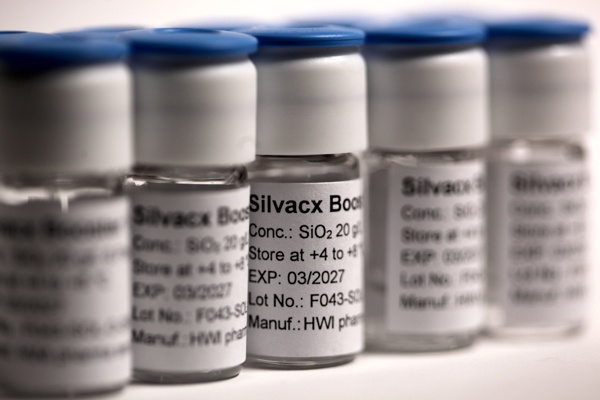
SilvacxBooster is a highly potent immunostimulant. The combination of pathogen-associated molecular patterns (PAMPs), which are loaded onto specially surface-modified silica nanoparticles, results in viral mimicry. The particles have the size and shape of small viral particles. By coating the surface with a TLR agonist, a virus is mimicked almost perfectly: highly immunogenic, but not pathogenic. After subcutaneous administration a potent immunostimulatory signal is sensed by innate pattern-recognition receptors and induces a type I interferon-dominated cytokine response. This leads to activation and maturation of dendritic cells and macrophages, strong activation of NK cells, and – at a lower magnitude – priming of T-cell responses, thereby amplifying both innate and adaptive antiviral immunity.

NK cells are a central component of anti-tumor immunity because they rapidly eliminate stressed or transformed cells without prior sensitization and remain particularly effective against tumors with diminished MHC class I expression. However, their cytotoxic function can be transiently impaired after surgical intervention, contributing to a temporary postoperative window of reduced immune surveillance. The postoperative period is a critical vulnerability window in cancer surgery because surgical stress transiently suppresses NK cell cytotoxicity and other anti-tumor immune functions. As a result, residual malignant cells and micrometastases may escape immune surveillance more easily and gain a foothold during early recovery. We developed the SilvacxBooster precisely to prevent this from happening.
Did you know that...
- any surgical procedure weakens the immune system heavily [1]?
In particular, the activity of NK cells is severely restricted for around two months [2]. Cytotoxic T cells are also weakened [3]. The more invasive the procedure is, the more the immune system is damaged [4]. Here is a detailed explanation of why the immune system is weakened by any kind of trauma. - a weakened immune system is extremely detrimental to the prognosis in cases of cancer?
It’s a dilemma: for the most common types of cancer, there is no chance of a cure without removing the primary tumour. The tumor must be removed. However, this leads to a weakening of the immune system, which – now that the immunosuppressive primary tumor has been removed – could otherwise tackle tumor residues, dormant micrometastases and circulating tumor cells. Yet it is simply no longer capable of doing so. Consequently, unfortunately, recurrences [5] and metastases [6] all too often occur following cancer surgery. - the effect of surgical procedures on the immune system – and the significant adverse side effects associated with them – have been known for over 50 years [7]?
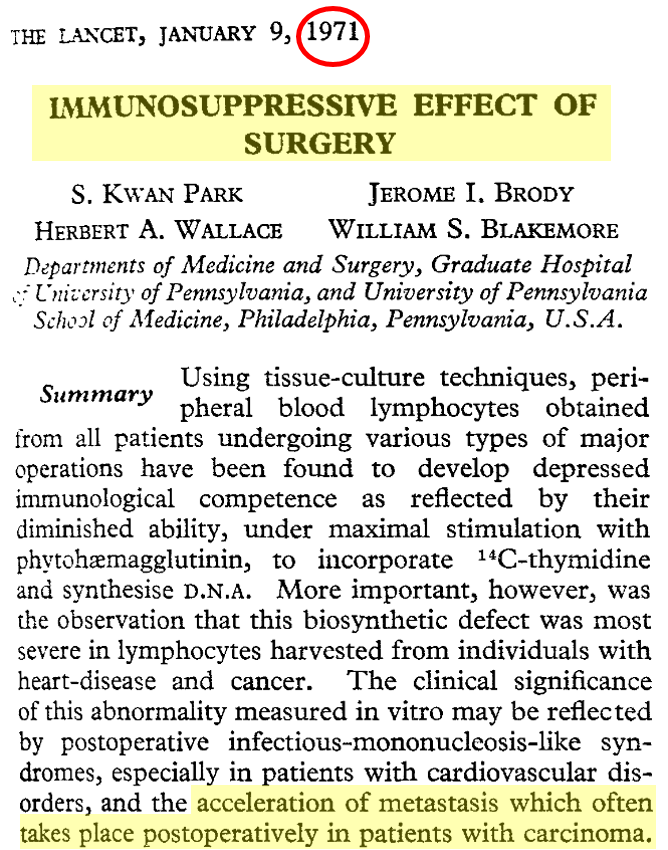
Yes, and unfortunately, the whole thing has simply been accepted as it is so far. - there is no immunostimulant authorised for use in humans that could meet this significant medical need?
Yes, and that is precisely why we developed together with OHRI the SilvacxBooster. The aim is to strengthen the innate immune system of cancer patients to such an extent that recurrences and metastases occur significantly less frequently following surgery. - around 10 million people undergo cancer surgery every year?
The market for this medicine is absolutely huge. However, to ensure that all patients have access to SilvacxBooster in the future – without causing health insurance schemes to collapse – the costs must be scalable downwards. This is guaranteed by our cost-effective, purely chemical manufacturing process. - administering a checkpoint inhibitor and SilvacxBooster could be the perfect combination?
Checkpoint inhibitors "release the brakes" [8] - SilvacxBooster repairs and tunes the motor! - SilvacxBooster is is on the verge of entering clinical trials in humans?
The most important preclinical toxicology studies have been completed. Efficacy in the transgenic mouse model was demonstrated using two different tumor models. SilvacxBooster was able to more than compensate for the effects of postoperative immunosuppression. In other words, the animals subjected to surgical stress developed fewer metastases than those not subjected to surgical stress. - we're looking for investors so we can test SilvacxBooster in a Phase I human trial?
We need approximately 4.5 million euros to have the SilvacxBooster manufactured to GMP standards and to be able to carry out the Phase I trial. We have a GMP roadmap, production quotations and a detailed trial protocol with a cost estimate for the Phase I trial.
FAQ Section
"Isn't immune stimulation after surgery risky — cytokine storm, autoimmunity?"
This concern is understandable and one we take seriously. The short answer: the preclinical data available so far give no indication of such a risk, and the study design is built from the outset to exclude patients at elevated risk.
What the preclinical data show
In dose-ranging studies and the GLP toxicity study, no signs of a cytokine storm were observed, even at very high doses. This is an important distinction from the clinical concern about an uncontrolled systemic inflammatory reaction, as seen for example in sepsis or with certain CAR-T therapies.
Why the subcutaneous route matters here
A key reason for this favorable profile is likely the route of administration. Subcutaneous injection deposits the compound locally, where it is only gradually absorbed and presented to the immune system via the draining lymph nodes — rather than reaching systemic circulation as a bolus, as with intravenous administration. This keeps immune activation more limited in time and space, rather than flooding the entire system at once. This principle is also why the vast majority of adjuvants in conventional vaccines are given subcutaneously or intramuscularly rather than intravenously: a contained, locally initiated immune response is fundamentally different from a massive systemic activation.
Why the planned trials exclude autoimmune and transplant patients
Even though the preclinical data are reassuring, we are not taking any unnecessary risk in trial design. Patients with known autoimmune disease, as well as organ transplant recipients, will be consistently excluded from the planned studies — in the former case to avoid potentially reactivating the underlying condition, in the latter to eliminate any theoretical risk of graft rejection driven by enhanced immune activity. These exclusion criteria are standard for any immunostimulant and will remain in place throughout the further clinical development program.
"Why is cytokine storm a known risk with other immunotherapies (e.g., CAR-T), but not here?"
The difference lies in the activation pattern. CAR-T cells expand endogenously over days to weeks, potentially releasing exponentially growing amounts of cytokines. SilvacxBooster, by contrast, delivers a single, dose-defined, externally controlled stimulus — comparable in magnitude to a vaccine adjuvant, not to a self-amplifying cell population.
"Could immune stimulation also impair wound healing?"
This is a reasonable concern given how closely inflammation and wound healing are linked — but the relationship is more nuanced than "less inflammation is always better for healing." A substantial body of psychoneuroimmunology research, notably the review by Gouin and Kiecolt-Glaser [9], shows the opposite pattern in one important respect: it is the suppression of local pro-inflammatory cytokine production — driven by stress hormones such as cortisol and catecholamines — that is consistently associated with delayed wound healing, not an excess of it. The early inflammatory phase of wound repair (neutrophil and macrophage recruitment, local cytokine signaling) is a necessary, healing-promoting step; dampening it, as chronic physiological or psychological stress does, is what slows healing down.
This is relevant here because surgical stress itself operates through overlapping neuroendocrine-immune pathways — elevated cortisol and catecholamines are part of the same physiological stress response that drives postoperative immune suppression more broadly. In other words, the postoperative window we aim to counteract with SilvacxBooster and the mechanism shown to impair healing in the stress-and-wound-healing literature are not unrelated phenomena. This raises a reasonable hypothesis: restoring immune competence during this window could support, rather than hinder, healing — provided the response remains time-limited and appropriately regulated, as the preclinical data indicate.
That said, we want to be precise about the limits of this reasoning. The cited literature concerns local cytokine dynamics at the wound site under psychological or endocrine stress, whereas SilvacxBooster is administered subcutaneously away from the surgical site and acts primarily via lymph node-driven, systemic type I interferon signaling. The two mechanisms are related but not identical, and this argument should be read as a plausible rationale rather than direct evidence of a benefit. Human wound-healing outcomes have not yet been studied with SilvacxBooster and remain an explicit safety and efficacy endpoint in our planned clinical trials.
"Could a general immune stimulation also promote tumor growth, given that some inflammatory pathways are tumor-promoting?"
Chronic, tumor-associated inflammation (e.g., driven by IL-6 and TGF-β from the tumor microenvironment) is mechanistically quite different from the type I interferon-dominated, NK cell-activating response triggered here. The latter is a classical anti-tumor signaling pathway, not a tumor-promoting milieu. This distinction is precisely what continues to be examined in the ongoing tumor models.